
Australia’s population in March 2026
On 31 March 2026, Australia’s estimated resident population was about 27.92 million. The Estimated Resident Population (ERP) counts people who usually live in the country. In the 12 months to that date, the population grew by 392,700 people, or 1.4 per cent. National growth reflects natural increase and net overseas migration. At state level, interstate migration is a further component.
What makes up population change
Natural increase — births minus deaths — was 100,600 over the year. Net overseas migration was 292,100. Together, these two components explain growth for Australia as a whole. Interstate migration means moves within Australia: when someone moves from New South Wales to Queensland, the population rises in the destination and falls in the state they leave. It does not add to or subtract from the national population. Net interstate migration is the balance of arrivals and departures; it describes the direction of change, not the total number of moves.
Differences between states
On 31 March 2026, New South Wales had 8.67 million residents, Victoria 7.15 million, Queensland 5.74 million and Western Australia 3.10 million. Net interstate migration over the preceding year was minus 20,818 for New South Wales, plus 14,718 for Queensland and plus 10,314 for Western Australia. These balances show how internal moves affect the distribution of residents. For total annual population growth, Western Australia led the states at 2.1 per cent, while Tasmania had the lowest rate at 0.6 per cent. Those rates include all components of population change, not just interstate movement.
Each state’s population reflects the same basic components: births and deaths, net overseas migration and its interstate migration balance. A state can therefore grow overall even when its interstate balance is negative, if the other components outweigh it. The population figures are rounded to the nearest ten thousand; migration balances are reported as people.
Sydney is a major population centre in New South Wales, but the state includes many other regions. Its population cannot be understood from the capital alone. These statistics show how natural change and migration shape regional population over time, providing context for New South Wales and for everyday life, culture and the economy across Australia.
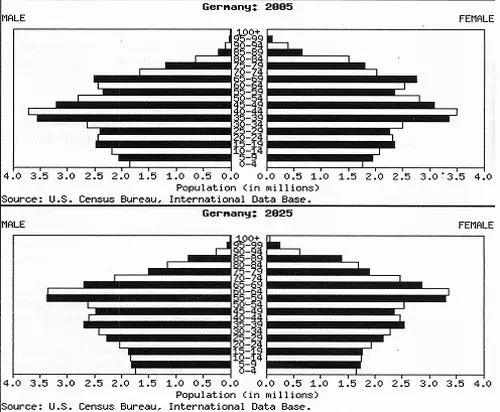
Historical population illustration, using the 2005 comparison.
Original contribution: Dieter Tischendorf
